
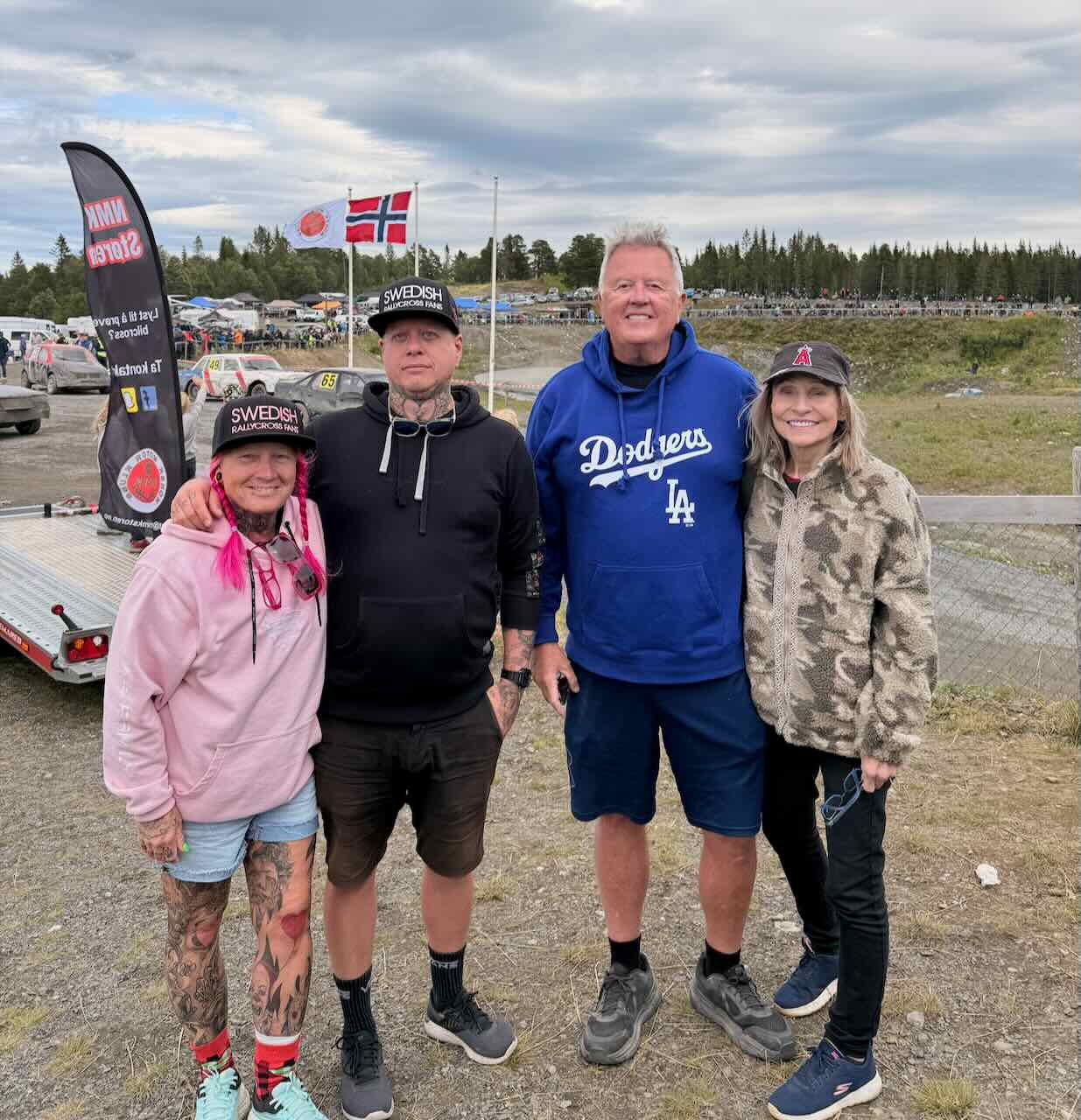

It’s Sweden, baby!
Keeping it simple. Saving you time.
Let’s keep this simple. The first half of today’s newsletter will be titled “Life on the Road.” The second half is called “Trackchasing.” If you have more interest in one of these subjects than the other, you can jump to your preference!

Life on the road.
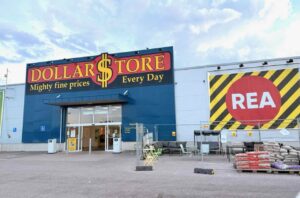
I love Dollar Stores in Sweden!
We bought “lawn chairs” in a Swedish dollar store at our first opportunity. We bought the lawn chairs at a Swedish-based retailer called the “Dollar Store.” That seemed like an unusual name for a store in Sweden, since the national currency is the krona, not the dollar!
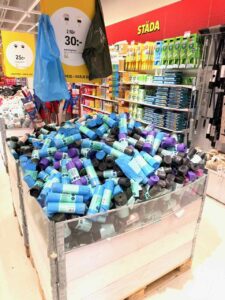
I love these kinds of stores. The merchandising in a Swedish dollar store is different from almost anywhere I’ve seen. They just dump hundreds of packages into a huge bin for consumers to pick from. That approach must save on labor costs.
Why lawn chairs?
Swedish racetracks, for the most part, don’t have grandstand seating for spectators. Fans bring their own chairs. Once we discovered this several years ago, we now bring our own chairs! We don’t want to bring chairs from the U.S. when we can buy them cheaply in Sweden. When we’re done with the trip, we just give the chairs to others.

Accommodations.
Before the trip, I booked all our hotels on Hotels.com. I used gift cards from a Chase Bank miles-and-points promotion. For today, I found the BigRiverCamp Hotel & Spa in Fölinge, Sweden.
Dumb and dumber.
I accidentally booked this hotel in mid-June when I needed it in mid-July. I emailed them and convinced them to let us stay in July for free after we had paid for our June room and didn’t show up. That was kind of them.
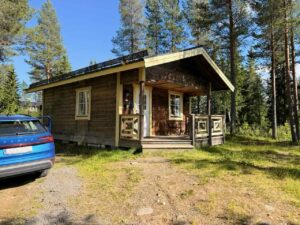
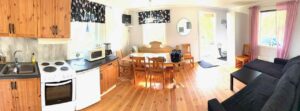
I had reserved our own individual cabin. If you look at the pictures, you will think of it as a quaint little place. Kind of Unabomber style. The cabin’s interior was clean and quaint. We were only there for one night.
I can’t ever treat Carol too well.
Over the years, I’ve spent more money on trips where Carol joins me. Remember, she “only” travels 60-70 days every year, and I travel 180 nights or more each year.
Who brings their own linen?
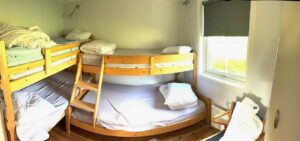
When we checked in at the reception desk, they asked if we had brought our own linen. I saw Carol cringe. The answer was a resounding no. I wasn’t aware we needed our own linen, but when you’re on the road and get information like that, you just roll with it. For 120 Swedish kroner or about $12 per person, we soon had our own linen. And yes, the cabin had double bunk beds!
O.K., I’m a sales guy. Carol says a sales guy will buy anything.
It was still early. Dinner wouldn’t happen for a couple more hours, so I asked the proprietor about our hiking options.
They get angry?
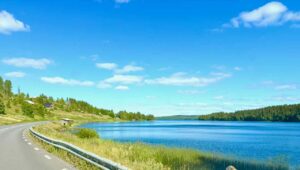
The check-in guy told me about a hiking trail that sounded interesting down by a beautiful Swedish lake. He also added, “The mosquitoes get angry at about 5 p.m.” It was about 5 p.m. The proprietor just happened to have some mosquito spray on the counter. I picked up a bottle and bought it. 17 bucks. I don’t buy mosquito spray all that often, but that seemed high. I wonder how many times he’s used the “the mosquitoes get angry” line before?
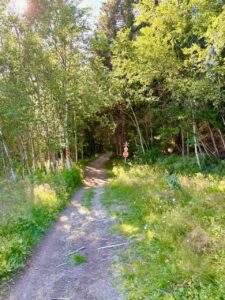
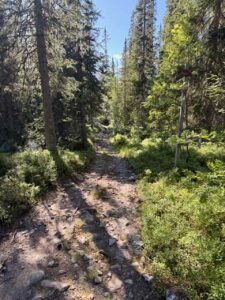
Brown bears? What the?
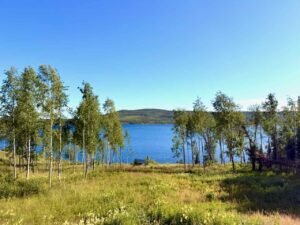
Carol went to the cabin to relax. I hopped in the car and drove about 10 km to the trailhead. Off I went. Later, I learned that brown bears frequent this area, but it was probably good that I didn’t know that during my hike!
I would consider the hike strenuous, considering these factors. I was wearing the equivalent of tennis shoes (Hey Dudes!) that were pretty worn and not well-suited for this hike. The trail went up and down, and there was a tremendous amount of large and small loose rocks. In places, it was muddy, almost too muddy to continue. I had to navigate quite a few tree roots. I wasn’t going to be gone for that long. I planned to walk 30 minutes in and 30 minutes out. After 20 minutes, I decided the trail conditions might be too much to continue, so I turned around. I didn’t see anyone else while I was in the woods. I was alone, except for whatever brown bears might be watching from a distance.
Pippin, my imaginary ChatGPT friend, gave me this advice.
Yes, ChatGPT told me the BigRiverCamp Hotel & Spa might be one of the best places for dinner in this very rural part of Sweden. We decided to eat in their dining room.
Carol is tolerant.
I ordered a margarita. Our server came back and told us he didn’t really have the ingredients to make a margarita. O.K. Carol ordered the cheeseburgers and fries and didn’t like that they served it with catsup. I don’t like catsup at all, and I would have returned the sandwich if I had ordered it. Carol is much more tolerant of poor service than I am.
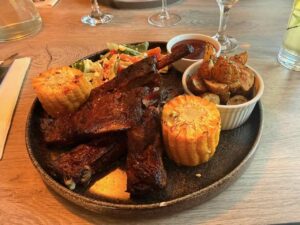
I ordered the most expensive item on the menu, the barbecued pork ribs. They fell off the bone, but they were pretty fatty, too. When we’re touring like this, we always like to sample and share a dessert. We ordered the chocolate fondant, a brownie with molten chocolate inside, plus vanilla ice cream and strawberries. It was tasty. Dinner, including a drink for each of us, was $77 U.S. That seemed a bit expensive for what we got, but it was an interesting experience. We had plenty of time to talk because the service was extra slow.
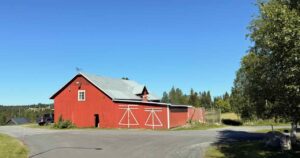
Yes, another hike.
This was definitely rural accommodations. After dinner, we took a nice, long walk on a flat gravel road until it was time to turn back. We never did experience the dreaded mosquitoes. Now I have a $17 bottle of mosquito spray that I will never use!
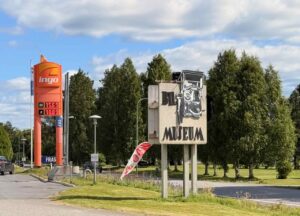
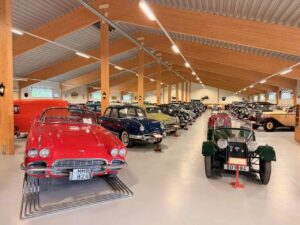
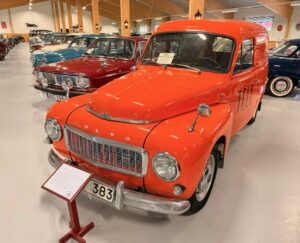
Auto museums are always a favorite for me.
After race #2, we headed north for about an hour to Ivars Bilmuseum in Hoting, Sweden, an automobile museum. I can’t recall whether Nicklas, AI, or both alerted me to this opportunity. I’ve visited several autumn museums in Sweden and was eager to add a new one. The museum was on the smaller side, but still most enjoyable.
Laid back? Yes, really laid back.
Not every trip that I take is going to go perfectly. That doesn’t bother me. Unless I am physically harmed, there is virtually nothing that could happen on a trip that would upset me. Of course, I am known as the most laid-back man most people know, so you would expect a pretty laid-back reaction to the circumstances that I can’t really control.
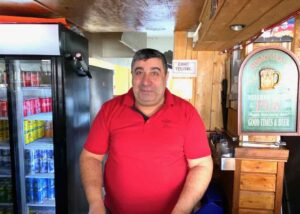
Nice guy!
During the drive to our hotel in Umeå, we passed through the small Swedish town of Åsele. It was here a few years back, during the middle of winter, that I popped into the local Åsele pizza parlor. The pizza and beer were great, but….I couldn’t pay for my meal! I had euros and credit cards, but the guy only accepted Swedish kroner. Not a major problem. The owner told me to exchange some money and come back in the morning and pay him. That’s what I did, and now every time I drive through Åsele, I stop and order a pizza. I showed the owner the photo I took of him on that fateful winter night. He didn’t remember! I’m sure he wondered why I wanted his photo in the first place.
We would be staying at one hotel for three nights. Every other hotel room would be for just one night.
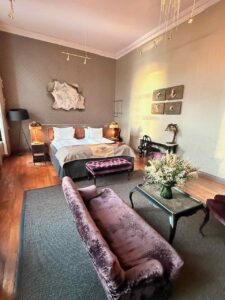
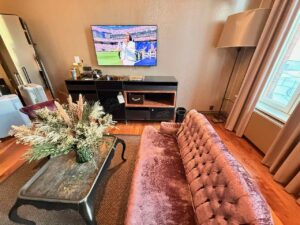
Carol gets upgraded!
For the longest stay, I upgraded Carol and me to an executive suite. The hotel had only one executive suite. Was it expensive? That’s all relative, isn’t it? I don’t think it’s prudent to tell you how much I paid because Carol is sitting right next to me as I dictate this. No one wants to know how much their present costs, do they?
This was a first.
In our executive suite, the hotel room safe wouldn’t work. Maybe it needed a new battery. Carol called the front desk, and they sent a repairman up. He thought it was a battery problem as well. It wasn’t. The repairman and his sidekick came up four times, but they never got the safe working.
How did we solve this problem? The solution was most unique. Despite staying in more than 7,000 hotel rooms in my lifetime (almost 4,000 in retirement), I have never had this particular solution to any problem.
They decided they had a room that wasn’t in operation, and that we could use the safe in that room. It was located just four doors down, so that would work just fine. That room was terribly small. It was “New York small.” I tried to point out to Carol that it was good that I hadn’t reserved a regular room for her and that she would be accommodated in the executive suite for three lovely nights. Yes, I’m always selling!
The best way to travel three miles in Sweden?
The next morning, our first tourist attraction was the Eliza Motormuseum in Umeå. Google Maps said the museum was less than 3 miles away, so we made a transportation plan.
I had a rental car, but it was safely parked in the hotel’s underground parking garage. The garage was small and difficult to get in and out of. I thought it was best to leave the car there during our three-day stay in Umeå.
Google Maps said we could take the bus; that would be fun, but the next bus left in five minutes, and we couldn’t make that. We’re from Southern California; public transportation isn’t a big deal. I figured the next bus would be in about 15 minutes, but it wasn’t. The next bus wouldn’t be coming around for three more hours. The front desk lady told us that we could also take the train. That would take nearly 4 hours. Gosh, the museum was less than 3 miles away.
Uber!
I decided we would take an Uber after confirming that the town of Umeå, with a population of about 100,000 people, had Uber. They did. I ordered an Uber with my American Express Gold card, which should give me a $10 credit. The fare was going to be $14 US. The driver came within one minute, but he didn’t speak English.
That’s one of the best things about Uber. You don’t have to sort out currency, and you don’t have to speak to the driver. They know where you want to go, and they will take you there without a word if that’s how you like to do things.
Soon we arrived at the address of the Eliza Motormuseum. It was in an industrial area, and our driver motioned, or probably grunted, that we had arrived.
Get out of my car!
However, I didn’t see a museum. I tried to point this out, and the guy drove around a little bit but really wanted us to leave the car because he had more work to do. Finally, without knowing exactly where the museum was, we left the car.
Do you know where the museum is?
We walked around, asking one person after another if they knew where the museum was, and nobody did. That seemed strange. We finally got into a long conversation with a fellow about 60 years old. He told us he had lived in Sweden for 40 years and had initially immigrated to Sweden from Iran as a student.
He offered to call the museum. Nobody answered the museum’s phone number. We concluded the place was closed. Out of business. Not operational. We tried, but not every part of my plans works out.
Everyone is different.
It was interesting talking to the man from Iran. There is no way in 100 years. I would’ve suspected he was from there, but he did have some feelings about the current US – Iran war. I won’t bore you with the details. He was only one data point. But no matter what you believe, it’s always interesting to talk to someone with their own point of view.
The good thing about our new friend Mohammed is that he was going to drive us back to downtown Umeå. It was probably just as fine and interesting to interact with someone like this as it would’ve been to go to the museum.
By the way, I never mind being lost and/or not being able to find things. We’ve had some of our best experiences when we were lost!
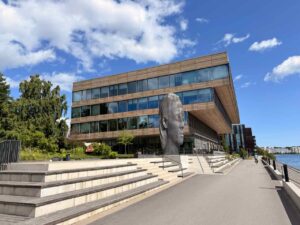
No art museum for you.
Yesterday we tried to visit Umeå’s number-one tourist attraction, the contemporary art museum. It was closed on Monday. The museum was only half a mile from our hotel, so we walked down the path parallel to the Umeå River. Wouldn’t you know it? The museum is closed on Tuesday, too. I guess Monday and Tuesday are their “weekend.” Not everything works out as planned, but I roll with the punches.
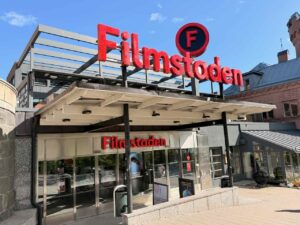
Ever been to a Swedish movie house?
We did have one positive experience. We went to the movies. There was a very modern, upscale movie theater with about six screens. We saw Matt Damon’s new film, The Odyssey. That’s not exactly my genre, but I think we both enjoyed it and thought it was better than we expected. It’s a three-hour-long film if that’s important to you. The most entertaining moments at the theatre? Watching the Swedish commercials before the film began!
Dinner…at the best restaurant in town.
For dinner, we had a reservation at a restaurant in downtown Umeå, just a couple of blocks from our hotel. When I asked AI for recommendations for good restaurants and activities on this trip, it told me this restaurant would be the highlight of our restaurant scene, and maybe the highlight of the entire trip.
When I got that information, I went on their Swedish-only website and made a reservation. I could enter our name and a couple of other details, but I couldn’t understand anything else.
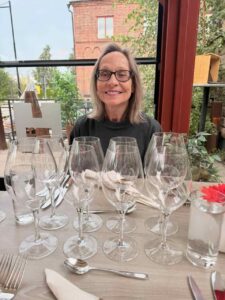
Were we in for a treat?
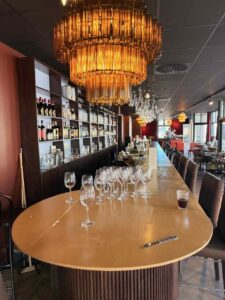
When we arrived at the restaurant, they welcomed us to a table with eight wine glasses already set out. The mildly snobby waiter came over and told us we were in for a treat. What was the treat?
We were going to get their special menu, which is updated once a month. The waiter gleefully told us the special experience would let us choose from a three-course, five-course, or seven-course dinner. Lovely.
Er?….really?
There was a bit of a catch. Yes, a bit of a dealbreaker for me anyway. Carol will eat anything? I go for meat, pasta, and pizza. No salads for me, no tuna or fish, though I do like shrimp, scallops, and lobster; still, I can be a picky eater at a fancy restaurant.
There were no menus at this restaurant. The waiter told us we couldn’t choose any of the food; they would simply offer their tasting menu, and we’d have to accept whatever they served. Really? That’s not how I roll.
That’s the way we’re gonna do it.
I tried to repeat what the waiter told us. Was it really true that they were going to serve us a series of foods that we didn’t choose, and if we didn’t like them, that was too bad? The waiter understood my question and answered nicely. Yes, that’s the way we’re gonna do it.
No, that ain’t the way were gonna to it.
Not exactly. Despite having a reservation and looking forward to this evening’s dinner, we suddenly weren’t going to have dinner here. I explained my decision to the waiter.
I’m not sure if anybody had ever given him this feedback so quickly. I got up, and he started rambling about people being on a waitlist and how this was a very special place, etc., and I said, “Thank you very much. It’s too bad we couldn’t work with you tonight.” Goodbye, and off we went. Not every part of my plan worked out, but it didn’t really bother me much.
We went to another restaurant where they’d turned us away the night before because they were full. Tonight, the maître d’ recognized me and found us a table.
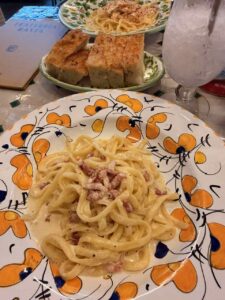
Our service was very, very slow. Honestly, we haven’t had fast service at any of the restaurants we’ve used, and Swedish food, for the most part, isn’t to my taste. I figured I couldn’t go wrong with pasta carbonara, which isn’t exactly a Swedish dish.
I had never had this happen.
Our server had been serving a party of four near us. When she left that table and came over to ours, she was explaining the desserts, and then all of a sudden broke down into tears and told us she had to go away.
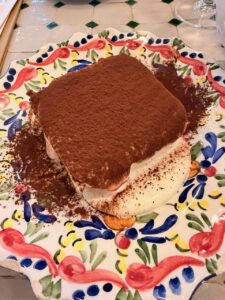
I did mention, just one time and in a pleasant voice, that our service had been really slow. They acknowledged that and told us we would get a 30% discount and free coffee and dessert to wrap up our meal. Carol had a cappuccino, and we had a piece of delicious tiramisu. It might’ve been the best tiramisu I’ve ever had.
Our bill still came to $77, even with a 30% discount and no charge for the cappuccino or dessert. Not complaining, just explaining.
We finished our evening by talking with the maître d’ on the way out. He was a young man, maybe 30 years old. He was originally from Brazil, but had immigrated to England, met his wife, and now she had a three-year employment contract in Sweden. Nice guy.
He told us the restaurant had served 430 people on this evening. He told us that people like the party of four might just be “having a bad day.” We commiserated over how devastated our female server was, but we left the restaurant having enjoyed the food and the people, although the service was really, really slow.
Take this one to the bank.
I always say, “People get a chance to choose their reaction to whatever circumstance they encounter.” I think when you think about life like that, the bumps in the road become a little less steep. You can have a plan, but not every part of it will work as well as you thought it would when you made it. No big deal.
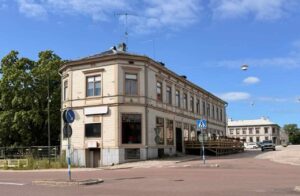
Late check-in, and the guy wanted to talk.
A couple of nights later, we checked into our hotel at nearly 1 a.m. The hotel itself was huge and used to be a private home. The hotel owner took the time to explain that he would much rather live in Sweden than in Southern California. He pointed out the laid-back atmosphere, lack of crime, and free healthcare. Those are all advantages of living in small-town Sweden, but they might also be the advantages of living in small-town Kansas. Of course, Europeans pay a higher tax rate, which he didn’t like admitting, for “free” healthcare, but he was more than satisfied with his living arrangement.
What did I learn from our meeting with this fellow? It’s never a good idea to “Yuk” on someone else’s “Yum.”
As I travel around the United States and around the world, I spend a lot of time talking to people. I have always found people in almost every circumstance really like where they live and have no incentive to live somewhere else. I know that very few people who live in Southern California would want to live in Mississippi and vice versa.
We always buy postage stamps.
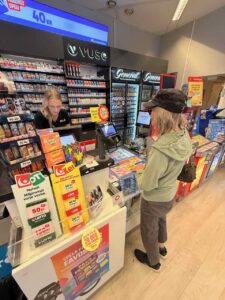
After breakfast, we walked around the small town to find postage stamps so Carol could mail her postcards. We stopped at a couple of merchants for directions and finally arrived at the post office.
I was surprised to see they were selling things like cigarettes and sodas. Maybe that’s what the United States Post Office needs to do to supplement its income!
The stamps cost more than the postcards!
How much did 11 postage stamps cost? How does $48 US sound? At least we got all of our postcards for free at the public library in Umeå.
What a great automobile option.
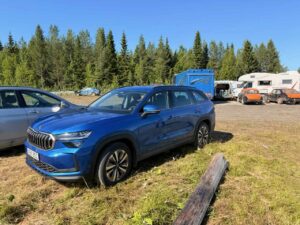
I’m still amazed by our Skoda rental car’s speed control system. It recognizes the speed limit and increases or decreases our speed based on changes in the limits. I’m hoping that will prevent me from getting any more European speeding tickets, and I’ve gotten my share.
Hey Pippin, what can we do for fun?
The next day, we had no racing planned. I asked ChatGPT what interesting touring activities we might find on the drive from one small town to another.
ChatGPT, aka Pippin, came up with three recommended items. The first was a small fishing village; the next was an old mine we could tour if we wanted. Finally, just off our driving route, was what was described as one of Sweden’s best castles. That would be our activity day. The weather was perfect, with a few clouds dotting a bright blue sky and a temperature of 19.5°C.
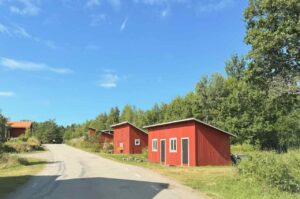
We made it to the small fishing village near Söderhamn. The “town” was so small that there really wasn’t even a place to park off the road. The village was made up of several small red Swedish cabins. Very picturesque. The best we could do was drive through and take a look.
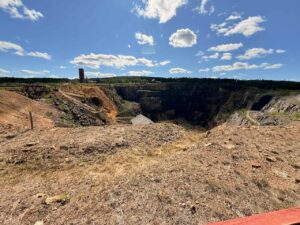
This one was fun and a challenge.
The Falun Mine was a totally different story. This was a relatively large tourist attraction. The highlight would be taking an underground tour of the mine, which at one time supplied two-thirds of Europe’s copper. The mine closed in 1992.
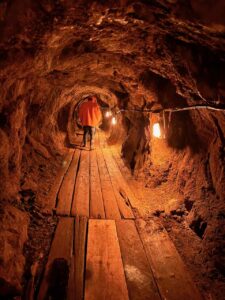
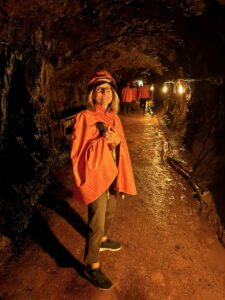
Carol and I joined eight others, all in our age range, and off we went to tour the mine 200 meters underground. That’s the length of two football fields!
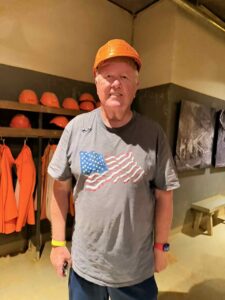
We were underground at that depth for an hour. They gave us hard hats and coats. The hard hat was important for me because at 6’3”, I had to duck to get through many of the tunnels, and I still kept hitting my head.
Our guide told us that in these conditions, things stay preserved essentially forever. The temperature down in the mine was about 55°, damp and dark, except for a few lights installed for the tour.
Do you believe this story?
He told us a story, I assume it was true, of a young man at age 22 who came into the mine on his own and then was killed by a partial collapse in the mine. They found his body 42 years later, and although he had the chronological age of 64, he was still preserved as a 22-year-old! The guide said the situation really freaked out his wife when she saw her husband 42 years later! I would imagine it would!
How dark is dark?
One more thing of interest was that during the tour, the guide told us that if he were to turn out the lights, we would go into complete darkness, and we couldn’t see our hands in front of our faces. He turned out the lights. It was true. 100% pitch black!
One of our most unique experiences ever.
Carol and I once went to a special restaurant on Sunset Boulevard in Los Angeles. They were somehow associated with the Braille Institute and wanted to help customers understand what it was like to be blind.
When we entered the restaurant, we put our hands on our server’s shoulder. He seated us at a table inside the restaurant. We were in complete darkness. Carol and I were in there for our full dinner for the next couple of hours.
I was very uncomfortable, but since the kids had given us a gift certificate, I couldn’t bail after 10 minutes. If you ever get a chance to try something like that, I recommend doing it just for the experience. I wouldn’t do it again on my own, but if I were with other people who had never had that experience, I would show up just to see their reaction.
Pippin, where should we eat?
As our drive continued, I used AI to pick an Italian restaurant still an hour up the road. We wouldn’t get there until 8:30 p.m., but Google told us they were open until nine.
When we finally arrived, a young greeter told us they were super busy. She said they had limited service and that it would take a long time to get our food. She didn’t really want to serve us. We were hungry, and I talked her into letting us sit at a table and wait as patiently as needed.
Real good Swedish groceries.
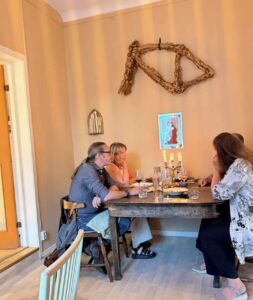
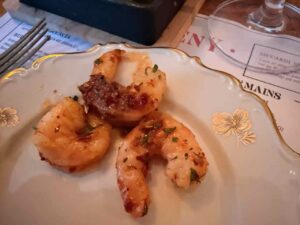
This was a tiny Italian restaurant with about five tables. The food ended up being delicious. We had pollo-stuffed tortellini, cannolis, and shrimp. All delicious. The restaurant owner came out to talk to us for several minutes. This place was only open on Thursday, Friday, and Saturday nights. He said that that was all the small town could handle, business-wise.
Everybody has a story.
This fellow was of Italian descent, but had lived in Orlando, Florida, for most of his life. He told us that living in a small town in Sweden was very different from living in the USA, but it had its benefits. He loved the five-minute walk from his house to the restaurant. His children disliked the Swedish winter climate. He told us his family lived in Sweden for the experience.
Surprisingly, everything I read said we’d likely see all kinds of wildlife, including moose and deer. We haven’t seen a single piece of roadkill in almost 3,000 km of driving. I find that amazing. In fact, Carol hasn’t seen a single wild animal on the entire trip, and we are out in the boonies.
What’s next?
Yesterday, AI recommended a copper mine tour, and we went 200 meters below the surface to check things out. Today’s AI idea was equally daunting. Pippin told us to go to Fulufjällets National Park to see Njupeskär Waterfall, described as Sweden’s tallest (93 meters, 305 feet).
But before that, we needed to have dinner. It’s much easier to ask Pippin for a good place to eat than to struggle to find a restaurant on our own.
The terrain is so rural that we might only see a gas station every hour or so, and we wouldn’t see a restaurant that often. AI recommended a restaurant just outside the national park, which was still two hours away, and we didn’t get there until 6 p.m.
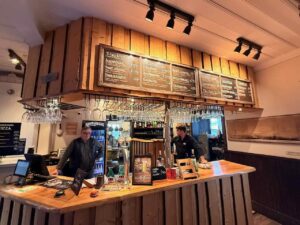
Which would you prefer?
They had moose slices on the menu, reindeer burgers, and char, a popular fish in northern Sweden.
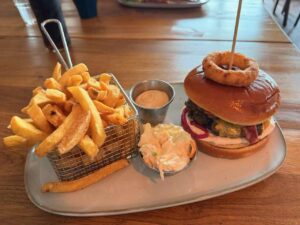
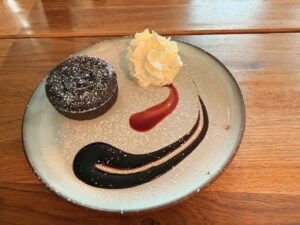
Carol chose the char, and I went with your basic cheeseburger and fries. Everything was delicious, and we topped it off with a serving of chocolate fondant for dessert.
Carol’s serving of char with potatoes and my cheeseburger with French fries and a Pepsi Max, and our dessert came to $89 US. Sweden can be expensive, and I think this part of rural Sweden was more expensive than anywhere we’d been so far.
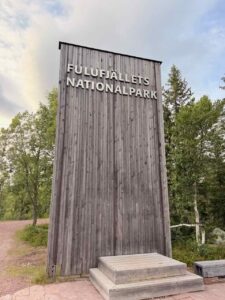
We made it. This was going to be a challenge.
We arrived at the national park at about 7 p.m. There was still going to be a lot of daylight because the sun doesn’t set in July here until around 10:30 p.m.
The restaurant owner told us this was the best time to visit the falls because the crowds would be down to nearly nothing late in the day, and that turned out to be true.
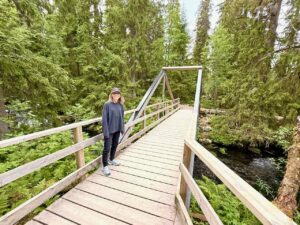
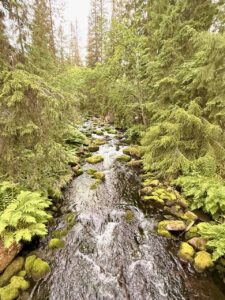
It was a 1.2-mile walk from the parking area to the Falls. This hike was not for the faint-hearted. We went in one way and came out another. Going in, we had to master some extreme inclines and avoid lots of large tree roots and exposed rocks. It definitely took us longer going in than it did walking out.
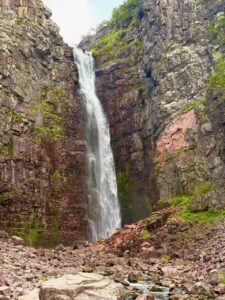
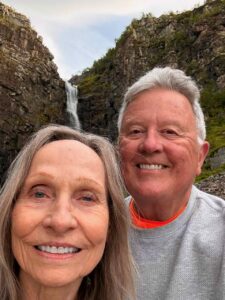
The Njupeskär waterfalls were described as the best falls in Sweden. We’ve seen a few waterfalls. Was this our best waterfall? We concluded it was not. But, this was still a great adventure.
Last night we were the last people to check into our hotel. Tonight, we were as well. I was happy to get out of the woods on the waterfall walk because the mosquitoes were starting to chew off my right leg.
Come on! Not this.
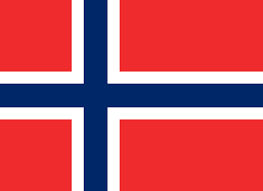
When we went to visit our first and only Norwegian track on this trip, we encountered a major problem. We had $156 US in Norwegian kroner. But our kroner was out of date. A newer currency had replaced it, and it was no longer accepted.
I did a quick search and found that we could send the old money to a bank in Norway, and they would credit our account with the currency’s value. I’ll work on that when I get back home.
We might be millionaires.
Carol keeps a stash of foreign currency from all the major countries we visit. How much is that stash? I have no idea. I don’t even know where she keeps it. Maybe we have hundreds of thousands of dollars of foreign cash just sitting around in our modest seaside cottage. Of course, more than half of that money could be out of date!
Norway: nearly unbelievable statistics.
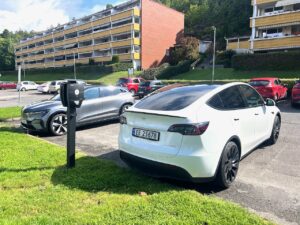
Norway is unique in one way. They are really into electric cars. I did some research and found that about 95% of new car purchases, and 98% in December, were electric cars in Norway.
I don’t know the details, but Norway offers some financial incentives to encourage its residents to drive electric. I can’t imagine any program that would convince 98% of new car buyers to buy an electric car unless they gave it to them for free, and although I think they do offer significant financial advantages, the cars aren’t free.
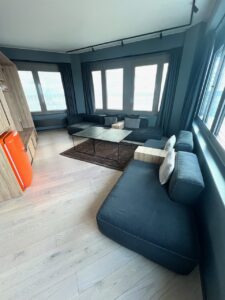
Here’s a Stockholm travel tip.
If you ever come to Sweden, specifically Stockholm, I highly recommend staying at the airport hotels on your arrival or departure day. We have always stayed at the Comfort Hotel, a 100-yard walk from the airport terminal. For this trip, I thought we’d try the Clarion Hotel, which is even closer than the Comfort Hotel.
At the end of the trip.
When we arrive back at the airport at the end of our trip, the rental car will be gassed up. I’ll drop Carol at the hotel so she can start getting organized, then I’ll return the rental car, take a rental-car bus back to the airport, and walk 10 minutes or less to the hotel. We’ve done all this enough in Sweden. We kind of know what the drill is.
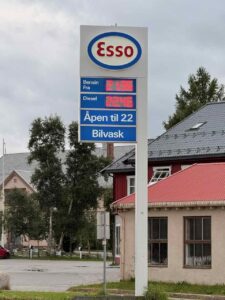
Noteworthy.
It was interesting to learn about the huge difference in gasoline prices between Norway and Sweden. Recently, Sweden made a tax-relief change that reduced gas prices to around $6.30 US per gallon. Just across the border in Norway, gas prices were $8.85 per gallon.
Diverted? Really? No problem. I’m laid-back.
I haven’t had a flight diverted for any reason in the past five years or maybe 10 years. Honestly, I can’t remember the last time one of my flights was diverted.
That all changed on the last day of our trip, coming back from Sweden. I flew from Stockholm to Zürich, and then the plan was to fly from Zürich to Chicago. However, when we approached Chicago in the middle of the afternoon, major thunderstorms had closed the airport. It’s unusual for Chicago’s O’Hare airport to be completely closed.
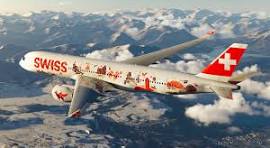
I was flying on Swiss Air. With the airport closed, they diverted us to the somewhat nearby Detroit. I felt for the passengers on “normal” tickets who needed to get to Chicago.
Once we landed in Detroit, they had us sit on the plane for more than an hour. Then they announced that a bus would arrive in another two hours to take passengers from Detroit to Chicago. For passengers with a destination beyond Chicago, that meant spending the night at the airport, or at least in Chicago, after flying from Switzerland. That’s no fun.
The pilots on our Swiss Air flight had “timed out.” By law, pilots and flight attendants can only fly so many hours in a day; once they reach that limit, they can’t work, and if they can’t work, the plane can’t fly.
Free at the proverbial bird.
When I got off the plane in Detroit, I was free as a bird. I really wanted to get to St. Louis later that day, and it didn’t matter to me whether we landed in Chicago or Detroit; getting to St. Louis would be about the same, which is exactly what I did.
Carol can hold her own.
Carol arrived safely home after connecting in Warsaw, Poland. It’s nice to have a wife who can handle that itinerary all by yourself.
Believe it or not, I will spend the next three weeks trackchasing. July and August are the busiest times of the year for my hobby because county fairs run then, and they only race there once a year. I think I’ll be gone for 34 nights, and I have a 26-night trip later this year.
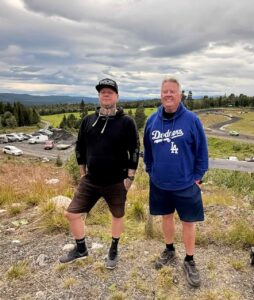
Nicklas is a good guy.
It was a good trip. It was nice to have Nicklas Akerlund on my team. He does the research for my Swedish trackchasing trips, and then we talk about which trip elements would be best to use.
Of course, Carol is a real trooper. She is the kind of wife who’s usually willing to “go along” for the betterment of the team. I’m lucky to have her.

25 years of life on the road.
I’m now in my 25th year of retirement. I don’t know what I would’ve done in retirement after retiring at an early age if I didn’t have my trackchasing travel hobby. It’s not worth worrying about. I DID have that hobby. I almost think I need to keep doing it at whatever level just to keep myself busy in retirement until I can’t do it anymore.
That’s it. Hope you enjoyed our travels to Sweden and Norway and the different adventures we encountered. It was nice to have you along.
Trackchasing!
Carol and I saw racing at six different tracks during this trip…in Sweden and Norway.
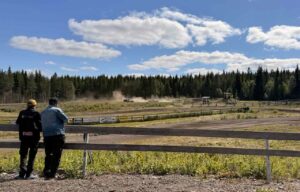
Fölinge Motorstadion, Fölinge, Sweden
We began the trackchasing part of the trip by first visiting the Fölinge Motorstadion in Fölinge, Sweden. This would be lifetime track #3,160 for me and #728for Carol. Did you know that Carol had seen that many tracks?
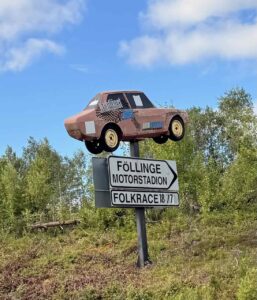
The track had a nice sign at the property entrance. They had a full-sized racing automobile hoisted high on a steel pole. I’ve seen that a few times. I like it. It’s a nice touch for a rural racetrack.
Benefitting from ignorance.
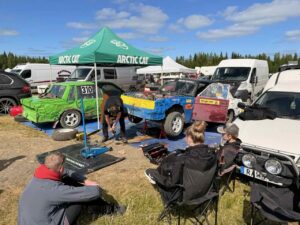
I randomly pulled into the track’s first entry road. That turned out to be the paddock. For non-racing fans, the paddock is where the racing cars are stationed when they’re not on the track.
Folk racing!
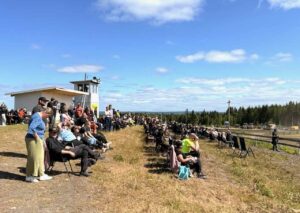
Today, we would see what is called “folk racing” in Sweden. All folk racing in Sweden is done on a road course. A road course configuration simply means the drivers need to turn both right and left to get around the track.
What is a mixed surface?
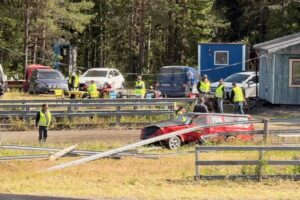
The track surface with this type of folk racing is called “mixed.” That simply means that part of the track’s surface is dirt, and part of the track is asphalt. Usually, a track like this is about 60% dirt and 40% asphalt. A mixed surface like this makes the race course more challenging for the driver.
Carol says I’m an opportunist.
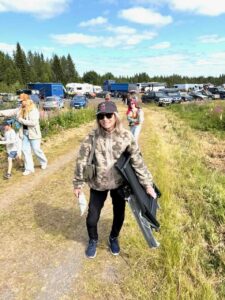
We could see that the track and spectator seating were 8-10 stories above the paddock level. Being the opportunist I am, I drove through the paddock area among the race cars until we found an open parking spot right at the base of the hill. From there, we joined people walking up to the spectator area. This was about as convenient as you could get.
Despite having seen racing at 26 different tracks across Sweden, I didn’t remember whether they charged admission. We arrived around 12 noon, and no one charged us anything to watch. A huge digital sign indicated they had already run 40 racing events. We would see another thirty during our time at the track.
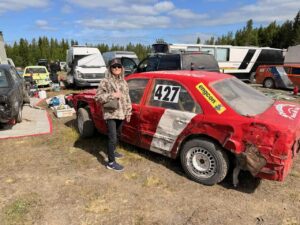
Folk racing means generally older, less expensive race cars. Many of the cars we saw racing today had been racing for years, and their bodywork was pretty beat up.
Folk racing is somewhat similar to rallycross racing. Just 4-6 cars start in a rallycross race. They run only 3-5 laps in most situations. That’s much different than racing in the States. Here the cars all start side by side from a standing start.

What the heck is the Joker lap?
An interesting feature of rallycross racing is something called the “joker lap.” Ever heard of the Joker lap?
In the middle of the track, the course splits into two lanes. One of those lanes is what creates the Joker lap. The Joker lane always takes a bit longer than staying on the regular course. The driver must take the joker lap one time and one time only during each race.
After driving through rain all last night, today’s weather was mainly sunny. Temperatures were in the low 60s. It was a very comfortable day.

We didn’t have Swish capability.
The concession stand only accepted online payment via Swish. To use Swish, we needed a Swedish mobile phone number. Swish is a lot like Apple Pay, but without the right phone number, we couldn’t use it. That meant we had to pay cash for concessions at these race tracks. No problem. Carol always had a stash of foreign currencies that we used for our grilled cheese sandwiches and drinks in Swedish kroner.
Today’s racing was in a rural location several hours northeast of Stockholm. Tomorrow’s race will be at a different track, but only an hour away. That meant our accommodations were somewhat limited. We had to choose from what was available in the countryside of central and northern Sweden.
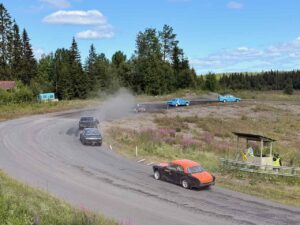
Tevalln Rejsvej – Gisselås, Sweden.
These Swedish names don’t exactly roll off the tongue, do they? This was our second track of the trip. It was my 28th track to see in Sweden and Carol’s seventh.
My Swedish friend Nicklas Åkerlund gave us directions to the town where the track was located, but we didn’t have a specific location for the track itself. Google Maps directed us along a rural two-lane, somewhat gravelly road until it told us we had arrived. At that point, we were in the middle of the forest. This was rural country. Up ahead, the road forked, and we could go left or right.
Can you hear me now?
This was one of the first times I had little to no cell service, so being in a rural area with no directions to follow left us in a bit of a quandary.
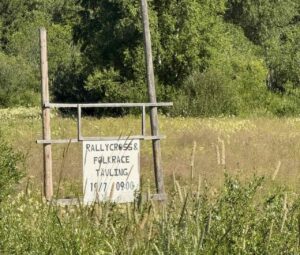
At the fork in the road, we decided to go left, and that was a good choice. We saw a track sign! The track entrance was just 100 yards up. Once again, I pulled into the paddock area, secured a good parking spot, and again we paid no admission.
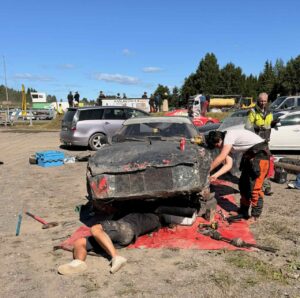
We spent a few minutes touring the paddock area. This let us see the race cars up close. That’s always a fun thing to do. In America, they always charge extra to enter the pit area, so being able to park in the paddock today and see everything for free was a nice bonus.
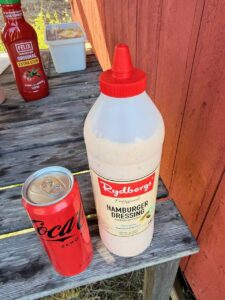
Our first stop was the concession stand because at 10:30 in the morning, we still hadn’t eaten anything. I went with their double burger and dressed it with what they call “hamburger dressing“. It was tasty. I downed it quickly with a Coke Zero.
Two different folks.
Carol never has as much luck with things as I do. Admittedly, I’m a little more aggressive and assertive, and if things don’t meet my parameters, I’ll probably get in somebody’s face until they do. Carol isn’t that way, and I sometimes find it frustrating that she seems to let these folks take advantage, but then again, I benefit from her persona daily in my interactions with her!
When she ordered coffee, they gave her only half a cup in a paper cup. She ordered a hot dog, one of the smallest I’ve ever seen, and later explained that the inside was mostly liquid meat. No, that didn’t sound very appetizing to me, but then I had just downed a very healthy-sized, delicious, cooked-over-the-grill double hamburger.
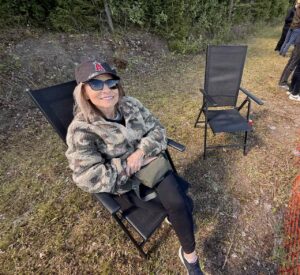
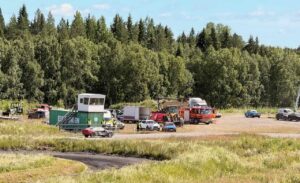
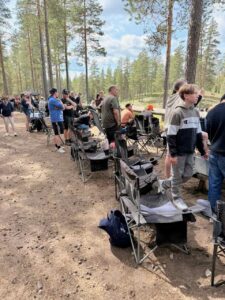
We hauled our $44-a-piece chairs up a large hill for a panoramic view of today’s dirt-and-asphalt rallycross track.
No delays.
The good thing about rallycross racing is that they run one race after the other with little delay. They don’t stop the races for yellow flags even when cars flip, and we did see three or four different flips today. They only put a corner yellow out and don’t stop the race. That keeps everything moving really well.
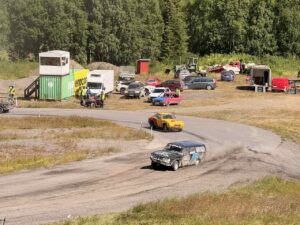
We probably watched 20-25 races, and we sat through a 20-30-minute track-prep period. During track preparation, they use large earth-moving equipment to smooth out the track, then water it, which is always a good idea because the dust was a little strong today.
Like a food buffet? How so?
The good thing about rallycross-style racing is it’s a little bit like a food buffet. These events usually start around 9 a.m. and go until four or five p.m. with a couple of breaks for track prep and lunch. That means in the course of the day, if you got there at the beginning and stayed until the end, you might be seeing 60 or 80 races. Today, there were 91 cars signed in, and one of the tracks we will visit later in the trip has 140 cars registered.
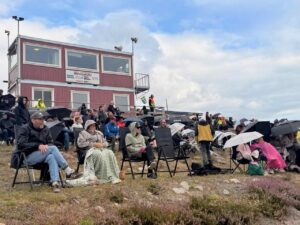
Lycksell Motorstadion – Lycksele, Sweden.
Today was our third auto race of the trip. They were having a two-day event. I misread the schedule and thought that the program started at 9 a.m., as most of the other races planned for our trip.
With a three-hour drive, I figured we would arrive for lunch and watch the afternoon racing. Nicklas, my Swedish travel advisor, had sent me notes on track locations, starting times, and things to do in the area. I missed the fact that racing wouldn’t begin until 4 p.m. We arrived at noon.
It did seem a little bit unusual that the racing rigs were just starting to pull into the paddock. A quick message to Nicklas, who was traveling with his wife, Susanne, in Norway at the time, reminded me that the racing wouldn’t start for another four hours!
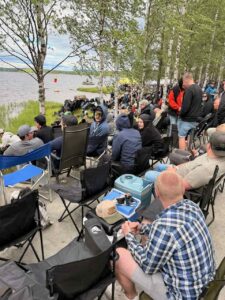
Snowmobiles racing on a lake?
Yes! My misunderstanding of the start time actually turned out to be a positive. It gave us time to drive about 5 km to where they were racing snowmobiles on a lake. This event was absolutely jam-packed.
We had to park far away and pay $20 per person to get into the viewing area. Well over 1000 people were already there at the edge of the lake watching the racing.
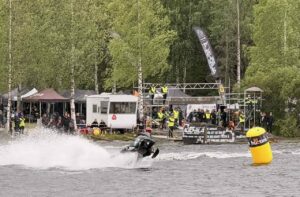
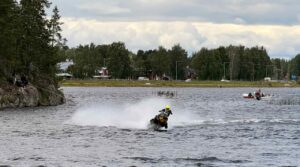
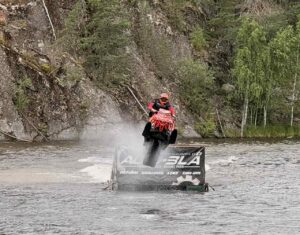
This was exciting. It was mid-July, and the wind was off the lake. It was chilly. Most spectators wore winter gear, and we only had sweatshirts. I got some great video clips of the racing, and we had a good time.
Today was the first day we had to pay an admission fee. They were charging 100 kroner to get in, which is about $10 US. Parking was an additional 40 kroner.
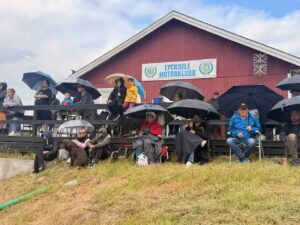
If you’re not early, you’re late.
When we arrived early, we placed our folding chairs in a prime viewing spot, and of course, they were untouched when we returned. Most folk racing, which is done on a rallycross-type track, is about 60% dirt and 40% asphalt. Today, that ratio was reversed. It seemed like maybe 70% of the track was asphalt. That certainly kept the dust down. We even had a quick rain shower.
With folk racing, each race is quick. Today, 4-6 cars would compete for three laps, and as soon as the cars finished and rolled off the track, the next green flag dropped.
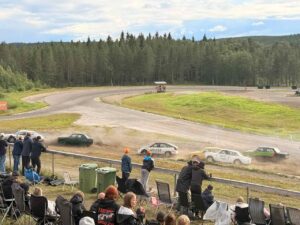
We don’t need to see every race.
With the racing starting at 4 p.m., they would have three “sessions.” Each session would be about two hours long, with roughly an hour break in between. That meant they would be racing until 11 p.m., just a few minutes past sunset. We planned to watch the first session for two hours. During that time, they probably ran 30 races, if not more. We also had plenty of time to walk around the paddock, taking pictures of the racers and the race-car haulers.
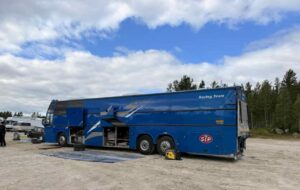
Big buses repurposed.
In Sweden, they commonly use these huge transport buses to move their race cars and house their racing teams. I have a buddy in Sweden, Simon Tiger, who showed me his bus. It sleeps 22 people!
One mistake often creates more problems.
If I had remembered the race was starting in the late afternoon, I wouldn’t have scheduled our hotel a six-hour drive away.
With today’s race in Lycksele, Sweden, and tomorrow’s in Fredericksburg, Sweden, we had a 9-hour drive to make. This evening we did six hours, and tomorrow a leisurely three. This is rural country, and there aren’t many hotel options.
The scenery was beautiful. The traffic was light. That’s been the situation for the entire trip. We listened to podcasts in our car for entertainment.
We’re gonna be late, real late.
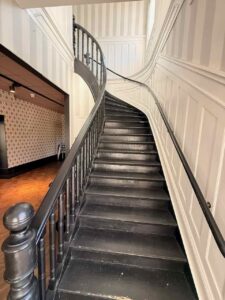
I called the hotel proprietor from the road and told him we wouldn’t arrive until after midnight. He was fine with that, and when we showed up, he was happy to see us and escorted us up a winding wooden staircase to our suite.
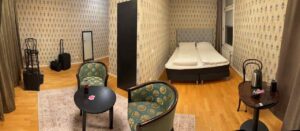
Whenever I can, I try to treat Carol to the most upscale accommodations available. We were told our hotel was a former private residence and dated back to the 1860s. The owner bought it four years ago and did some remodeling, but said much of the building was untouchable because it was an historic monument in Sweden.
Tyfersbanan – Tyfors, Sweden
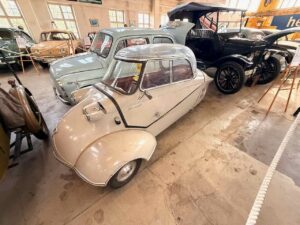
The next day, we headed to Tyfors, Sweden, for our fourth race of this six-track trip. Along the way, we saw a sign for a motor and a nostalgic museum and had to stop.
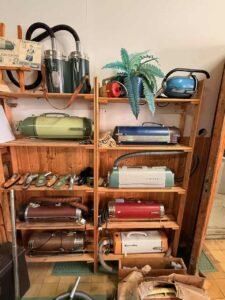
Worth the brief stop.
This was a most unusual place. It had a few cars, but also huge collections of typewriters, vacuum machines, and lots of other off-the-beaten-path items. We were only there for 30 or 40 minutes, but it was definitely worth the stop.
Today was day #9 of our Sweden adventure. I doubt most people would want to spend a day of their European vacation the way we did, but as they say, “There’s an ass for every seat.”
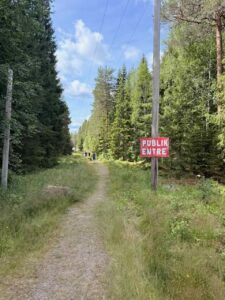
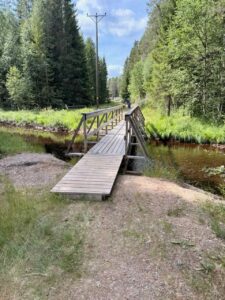
We are traveling in northern Sweden. The landscape is lush with constant green forests. The roads are generally in very good shape, and traffic is light. Even the walking the path to enter the track was beautiful.
Most of the race tracks we are visiting are far apart. Coming into this trip, I had already been to Sweden five times and seen racing at 26 tracks. That meant the remaining tracks were likely to be farther apart.
Lots of driving.
For the most part, and for most of our days, it’s a three-hour drive in the morning to get to the track and then a three-hour drive after the afternoon races to be positioned for the next day of the trip. I don’t think most people would want to vacation that way, but it’s sort of routine for Carol and as the world’s top two trackchasers in the universe.
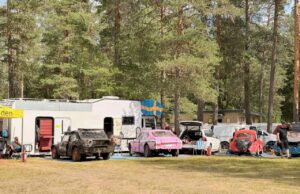
The number of racing entries at Tyfersbanan was probably the largest, at well over 100. At the same time, we probably enjoyed this track the least because we sat in an area where we really couldn’t see the cars well. The mixed surface, dirt and asphalt, 6/10-mile road course was hilly and had a large number of trees that often blocked the view.
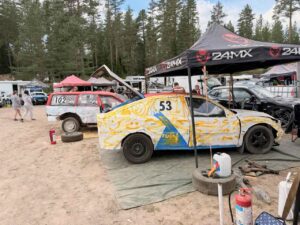
We positioned our chairs as best we could. We spent quite a bit of time in the paddock area, getting photos of the most unusual folk racers in attendance today.
Free!
For the third time in four races, we weren’t charged admission. We arrived a little bit before noon. So, to save our appetite, we only had Magnum ice cream bars at the concession stand.
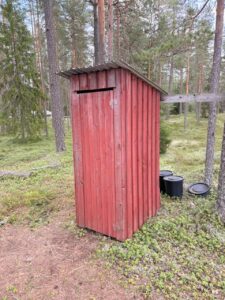
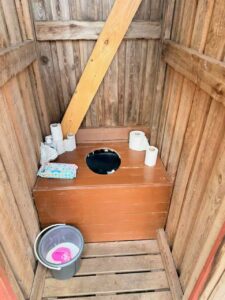
The facilities were rustic. Many racers brought their own campers and stayed in them for the weekend. The bathrooms were true outhouses. No exaggeration there. All part of the fun!
The above sums up what we did: about six hours of driving, maybe more. We saw one full race, one waterfall, and had a decent early supper. It’s not exactly like a day touring New York City, but we knew that before we came here.
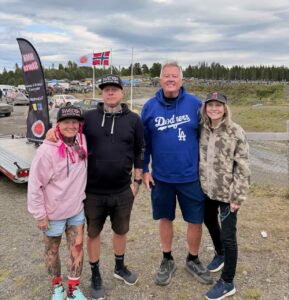
Finally. Trackchasing in Norway.
Today, we were seeing a race in Norway, the fifth of six tracks on our agenda. This was my third trackchasing trip to Norway and my fourth ever Norway racetrack. We met up with our good friend Nicklas Åkerlund and his significant other, Susanne.
They’ve been on their summer vacation camping all across Sweden and Norway, so it was good to meet up with them again.
Lost?….or stolen?
Before the trip, I bought a couple of racing shirts for Nicklas to thank him for all the organizational input he gives me on these trips. Carol packed them in a nice gift bag, and I thought I put them in my luggage, but we haven’t seen them since we started the trip.
This was most concerning to me. The racing shirts I had for Nicklas were unique and would be very difficult to replace. We ended up calling every hotel that we’ve already stayed at on this trip to no avail.
Now we’re thinking maybe we left the shirts back home and never brought them on the trip in the first place. If that is the case, that would be good because we can just mail it to Nicklas in Sweden. I’ll keep you posted on how this turns out.

Stolen!
Editor’s note: We have now concluded that the shirts mentioned above as missing were actually stolen. My electric toothbrush was also missing, along with a couple of other things. There’s no way we left all of these items behind by mistake. I can never recall anything being stolen from me by a hotel staff member.
Today, we were entering Norway just for the day. Last night we stayed in Sweden and will stay in Sweden tonight as well.
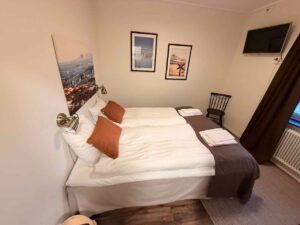
Small and expensive.
Last night’s hotel put us in a double-bedded room measuring 9’ x 10’. That was small. The room was not inexpensive either. It cost us nearly $200 for the night.
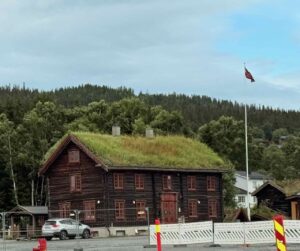
Norway is the poor step-sister to Sweden.
As soon as we crossed the border into Norway, things were different than what we had seen in Sweden. The houses were a bit more run-down and needed a fresh coat of paint; the scenery wasn’t as lush and green. That’s compared to what we had been experiencing in Sweden. The roads were narrower and not in as good a shape. Norway and Sweden definitely had a different vibe.
Now that’s quite a bit of driving.
We’re gonna have our rental car for 10 days, and it looks like we will be driving just a little bit more than 4,000 km, which is just a little bit more than 2,500 miles in 10 days. Also, consider that we didn’t really use the car at all for three days in the middle of the trip, so that’s almost 2,500 miles over a seven-day trip. That’s a lot of driving.
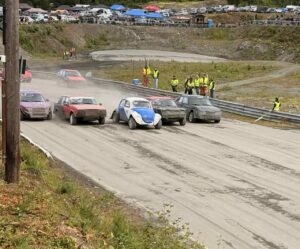
Ulvstuhaugan Motorbane.
This Norway track has an unusual name. Wouldn’t you agree?
This is the fourth summer season that Nicklas has helped me with my Swedish racing plan, including 2022, 2024, 2025, and 2026. We’ve met him on each of our Swedish visits, except last year in 2025.
Overcoming minor obstacles.
We ran into a couple of obstacles as we entered the track. First, the parking near the racetrack seemed full, as our young Norwegian ticket seller explained.
She wanted us to walk well over a half mile straight uphill on a muddy road and park in the overflow lot. I immediately reminded her that Carol has a bum knee and that kind of walk wouldn’t suit her. The young woman stuck her head in the car, noticed Carol still had two knees, and assumed one of them must be the bum knee, so she let us drive all the way up the hill and park in the paddock itself.
What to do when you have money, but it’s bad money.
Admission for today’s race for the two of us was 300 Norwegian kroner. Carol pulled out some Norwegian cash from a previous trip, which was likely nearly 15 years old.

We were soon informed that our Norwegian cash was out of date. It had been replaced by a newer currency version. The ticket taker would not accept our Norwegian kroner, and they wouldn’t accept our credit cards. What would they accept? Only Norway’s version of Sweden’s Swish, which we don’t qualify for.
A useful solution.
That was a major problem. Rather than cause an international incident, the young woman told us not to worry about paying, and we went on.
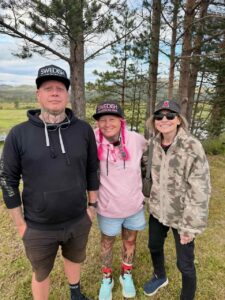
Nicklas and Susanne.
We soon met up with Nicklas and Susanne, who had arrived just a little bit before us. Right now, Suzanne has a severely sprained ankle, and they had to walk up that steep, muddy hill, so that must’ve been painful and inconvenient.
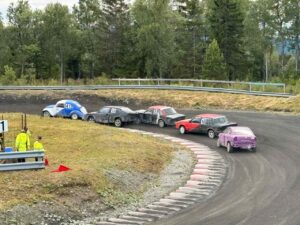
We watched the Norwegian folk racing from every part of the track and toured the paddock area. In Sweden, this is called folk racing, but in Norway, it’s called billcross.
Fun with our Swedish friends.
After the races, we went to a nearby shopping center so our companions could buy items that aren’t available in Sweden. From there, we found a nearby restaurant, had a nice dinner, and caught up on all the news since we last saw them.
Then we drove three hours to our hotel in Sweden. It’s nice that you can now go from one European Union country to the next without stopping to get any kind of clearance at all.
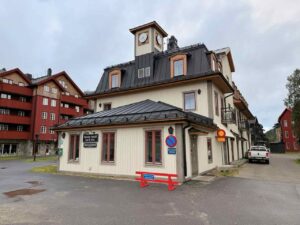
Not particularly convenient.
Tonight’s hotel in Sweden was in a ski resort, a huge ski resort. They must’ve had parking for 1,000 cars. On this summer evening in Sweden, there couldn’t have been more than 10 or 20 cars in those lots.
The check-in and check-out procedures were unlike anything I’d seen, despite all the hotels I’ve stayed in. They gave us a six-digit arrival code, and at checkout, we had to punch it into a strange-looking machine. A window popped up and opened. I put the keys in the window; a few seconds later, it closed. Everybody we saw, including us, had a difficult time operating this machine. I know it saves labor by not having an employee there to check you out, but it creates a good deal of angst for hotel guests.
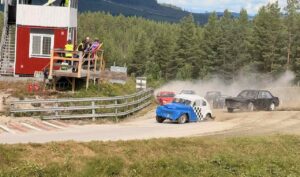
Halvfari Motorstadion – Hede, Sweden.
Today’s drive to the racetrack was a quick 30 minutes. It was nice to have such a short drive. Once again, we met up with Nicklas and Susanne. We watched the races from different points around the track and toured the paddock.
I always take lots of videos and photos with my iPhone at these race events. I shot one video clip that included the start of the race, and during the first lap, a car flipped side-over-side. The car came to rest. The driver jumped out and ran to safety, and when the cars came around that part of the track, they just kept going. There were no race stoppages despite a car taking a major header. In the United States, if that had happened, the entire race program would’ve been delayed by 10 or 15 minutes. That’s one advantage of folk racing. Each event has a maximum of six cars and runs for 3-5 laps, and when one race finishes, the next one starts within a minute or two.
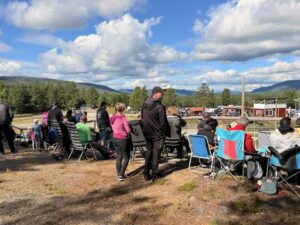
We now had two extra lawn chairs.
When we began the trip, we started at a dollar store and bought a couple of folding chairs for $44 each. That’s quite a bit more than we’ve paid in the past, but I guess inflation is hitting everywhere.
We always buy these chairs so we can sit anywhere we want at the racetrack. Swedish tracks like the ones we are visiting do not have grandstands. Then, at the end of the trip, we just leave the chairs for anybody who wants to have them. For this trip, we gave our chairs to Nicklas and Susanne. I think they’re going to give them to one of their kids. I’m glad to see them put to good use.
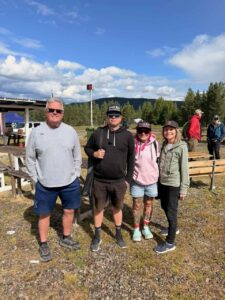
This will be our last night in Sweden. We need to wrap up a six-hour drive from the racetrack to Stockholm to get ready for tomorrow’s early morning flights.
Most of the trip was on two-lane roads that were in good condition, surrounded by huge, dense green forests. The problem is that the speed limits are so low. At times, we were driving at 45-50 miles an hour, which is why the drive took so long.
Time to leave Sweden.
On Monday morning, after departing Southern California 12 days ago, we’ll head back to the States. Carol will fly on LOT Polish Airlines and connect in Warsaw to Los Angeles. I, on the other hand, will take a KLM flight, connect in Amsterdam, and land in Chicago.
I will continue my trip for another three weeks. I’ll be trackchasing on almost every day of that trip. Our grandson, Mitch, will join me in the Midwest for a week of county fairs and corn dogs, and cinnamon rolls in Missouri, Illinois, Nebraska, Minnesota, and Iowa. That should be fun.

Next time.
My next newsletter will cover my most popular subject. What’s that? Randy’s Financial Plan of a Lifetime! Don’t miss it.